




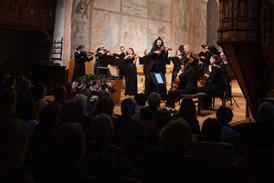



Pwyll ap Siôn attended Royal Northern Sinfonia’s performance celebrating Steve Reich’s 90th birthday on 3 October 2026, comprising works by Reich and Bryce Dessner
Discover more Featured Stories like this in The Strad Playing Hub
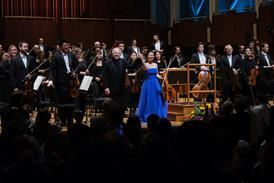
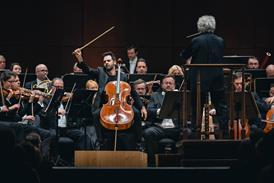
The two quartets on this programme of chamber works by Steve Reich and Bryce Dessner, performed by members of Royal Northern Sinfonia, proved to be the highlight of an engaging and absorbing concert. Part of an entire weekend of events at the Glasshouse International Centre for Music, curated by percussionist and conductor Colin Currie to celebrate Reich’s ninetieth birthday, the first half of the concert comprised four chamber works by Dessner.
The American guitarist and composer’s interest in Reich’s music goes back to the first time he heard Electric Counterpoint as a teenager. Dessner told me when I interviewed him a few months ago that the piece ‘changed the way I thought about music and the electric guitar.’ Garcia Counterpoint acknowledges and extends this influence, starting where Electric Counterpoint ends before following its own creative course. Dessner’s guitar writing is, in fact, more varied, with high melodic patterns, bass-line riffs and chiming chords shifting within the space of a few seconds. His refined guitarist’s sensibilities certainly shone through.
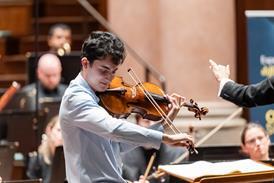
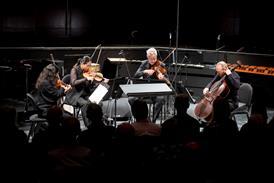
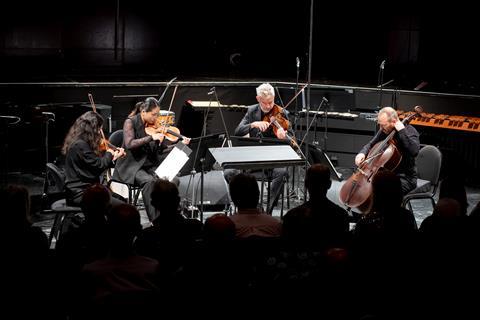
This was followed by Dessner’s Ahyem for string quartet. Meaning ‘homeward’ in Yiddish and based on the concept of flight, the intense single-movement composition felt far more than the sum of its eight minutes. Superposing driving, homogeneous rhythms with Reich-style close counterpoint, Ahyem also offered a rich inventory of textures and techniques for the string players, from accented arco and pizzicato passages to natural and artificial harmonics, col legno, sul ponticello, ricochet and spiccato. Dessner’s quartet was given an appropriately visceral performance by Eva Aronian and Haruno Sato on violins, James Slater on viola, and Daniel Hammersley on cello. All four players dug deep during the work’s fiery opening exchanges before producing a scintillating symphonic sound in an explosive ending.
After the delicate Tromp Miniature, performed by Currie on marimba and crotales, and the folk-like, seven-movement Murder Ballades for chamber ensemble, the mid-afternoon concert concluded with Reich’s Different Trains. As many will know, Different Trains for string quartet and pre-recorded tape weaves a series of parallel narratives around the concept of rail journeying, juxtaposing the composer’s exciting and romantic childhood trips across America during the late 1930s and early 1940s with the plight of European Jews travelling on very different trains towards the Nazi extermination camps at around the same time.
The work’s powerful impact is intensified by Reich’s use of speech recordings, some drawn from the composer’s personal interviews with his former governess, Virginia Mitchell, who accompanied the young boy on these travels, and retired Pullman porter Lawrence Davis, alongside the voices of Holocaust survivors sourced from the Fortunoff Video Archive at Yale University and the Wiener Oral History Library at the New York Public Library.
Given the importance of these speech phrases, a convincing performance must maintain a precise balance between the live quartet and pre-recorded elements: three quartets, voices, train and other sound effects. I’ve been fortunate to hear Different Trains several times this year, but this was by far the most effective performance in mixing these elements. Huge credit should go to sound designer, editor and engineer Ian Dearden of Sound Intermedia, who ensured that Reich’s original audio samples could be heard clearly above the pre-recorded string parts.
The live performance was equally assured, with the quartet ratcheting up the drama towards the end of the first movement, ‘America – Before the War’, while the paradiddle pattern heard in the second, ‘Europe – During the War’, was weighed down with an oppressive intensity. The quartet also managed to project an almost mocking tone in the phrase ‘and they loved to listen to the singing, the Germans’ in the third movement, ‘After the War’. This was a Different Trains du jour, in which the original work’s 1980s technology is transformed into a present-day masterpiece while retaining its uniqueness and originality.
In our upcoming November 2026 issue, Pwyll ap Siôn talks to leading players of Reich’s work to find out how they deal with its challenges. The November 2026 edition of The Strad is on sale on 7 October 2026.











No comments yet